

Why Knife Laws Matter
Knives are among humanity's oldest and most versatile tools. From the elegant chef's knife to the rugged hunting blade, from compact pocket knives to impressive bowie knives — millions of Americans carry, collect, and use knives every day for lawful purposes: cooking, camping, hunting, fishing, self-defense, and craftsmanship. Yet unlike many other tools, knives occupy a complex legal space in the United States. Federal law, state statutes, and local ordinances all layer on top of each other, creating a patchwork of rules that can trip up even the most law-abiding knife owner who crosses a state line or city limit without realizing it. This guide is designed for everyone in the knife community — whether you collect Karambits, daily-carry a folding pocket knife, own a prized Bowie, or hunt with a fixed-blade skinner. Understanding the law is not just smart; it is essential for protecting yourself, your collection, and your freedom.

Federal Knife Laws: The Foundation
Before examining individual states, it is important to understand the federal framework that applies across all 50 states.
The primary federal law governing knives is 15 U.S.C. §§ 1241-1244, commonly known as the Federal Switchblade Knife Act. This law does not ban possession of switchblades it restricts interstate commerce in them. Specifically, it is illegal to:
- Ship, transport, or cause to be transported switchblades or gravity knives in interstate commerce
- Import switchblades into the United States for sale or distribution
- Introduce switchblades into interstate commerce
This means many retailers will not ship automatic knives (switchblades) across state lines to individual consumers, even if the knife is legal in both the sending and receiving state. Local purchase or in-state retail is the safest approach.
Federal Locations: No Knives Allowed
Regardless of state law, federal law prohibits knives in the following locations:
- Secure areas of airports and aboard commercial aircraft
- Federal courthouses and courtrooms
- Federal prisons and detention facilities
- U.S. Capitol building and grounds
- National Parks — check specific park rules, as some allow hunting knives
- Other secure federal buildings and installations
The Interstate Transport Act (Proposed)
As of early 2025, S. 246 — the Interstate Transport Act was reintroduced and passed by the Senate Committee on Commerce, Science, and Transportation in February 2025. If enacted, this bill would protect law-abiding knife owners traveling between states from conflicting state laws, provided the knife is legal in both the origin and destination state and stored properly. This mirrors similar protections already available for firearm owners under FOPA.
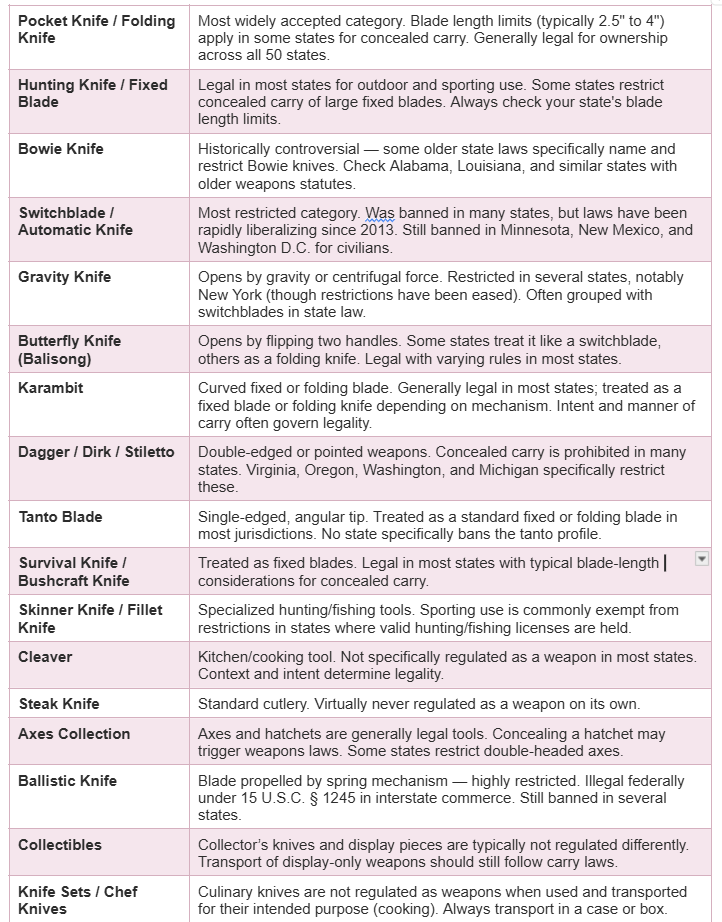
Understanding the Knife Types: What You Carry Matters
Top 5 Knife-Friendly States: Where Blade Enthusiasts Thrive
TEXAS: The Blade Freedom Capital
Texas is widely regarded as the most knife-friendly state in the nation. After Senate Bill 1473 took effect in 2017, Texas removed most criminal penalties around knife carry. The Lone Star State does not ban any knife type at the ownership level. You can own a Bowie knife, a karambit, a hunting knife, or any blade in your collection without legal concern. What Texas does regulate is carry in certain locations for knives with blades over 5.5 inches. The state calls these 'location-restricted knives.' They are perfectly legal to own and even carry in most places — but bringing one into a school, church, polling place, courthouse, racetrack, or bar (serving alcohol) is a criminal offense.
UTAH: Maximum Freedom, Minimum Rules
Utah may be the most legally uncomplicated state for knife owners in the entire country. Following HB 60 signed in 2021, Utah amended its concealed weapons statute to apply only to concealed firearms — entirely removing 'dangerous weapons' from the concealed carry prohibition. In plain English: you can legally carry virtually any knife concealed in Utah, including switchblades, karambit, bowie knives, and large fixed blades. Utah law does not define 'knife' as a prohibited weapon. A knife only becomes a legal issue based on its manner of use or intended use (Section 76-11-101). This use-based rather than type-based framework is the gold standard for knife-friendly policy.
OHIO: A Modern Reform Success Story
Ohio's transformation into a knife-friendly state is one of the best examples of recent legislative reform in the country. Prior to April 2021, Ohio had complex restrictions on knife carry that created legal uncertainty. Since the law change, Ohio removed statewide concealed-carry restrictions for most knives, legalized automatic knives, and adopted statewide preemption. Today, Ohio's knife law focuses on behavior and intent rather than blade type or length. As long as you are not using or intending to use a knife as a weapon and you avoid prohibited locations (schools, courthouses), Ohio is as permissive as Texas or Utah.
ARIZONA: Desert Freedom
Arizona has a deeply ingrained culture of individual rights and personal freedom, which extends naturally to knife laws. The state allows all knife types, has no blade length restrictions, and pre-empts local governments from enacting stricter rules. It is legal to openly carry any knife in Arizona without restriction.
For concealed carry, adults 21 and older can carry a concealed non-pocket knife without a permit — but they must disclose the knife's presence if stopped by law enforcement. Under-21 individuals may not carry non-pocket knives concealed.
OKLAHOMA: The Quietly Permissive State
Oklahoma does not get the same headlines as Texas or Utah, but it is one of the most permissive knife states in the nation. Oklahoma statutes list several banned weapons — but notably no knife appears on those lists. The state broadly allows open and concealed carry of knives, has statewide preemption, and has not placed blade-type or blade-length restrictions on law-abiding adults.
The focus in Oklahoma is almost entirely on location and intent. Carry a knife onto school property or into a government building and you have a problem. Carry it to the hunt club or the workshop and you will never have legal trouble.
States to Know Well: Higher Restrictions
California: Complex Layered Laws
New York: Patchwork of State and Local Laws
Minnesota and Washington D.C.: Switchblade Bans
Illinois: The FOID System
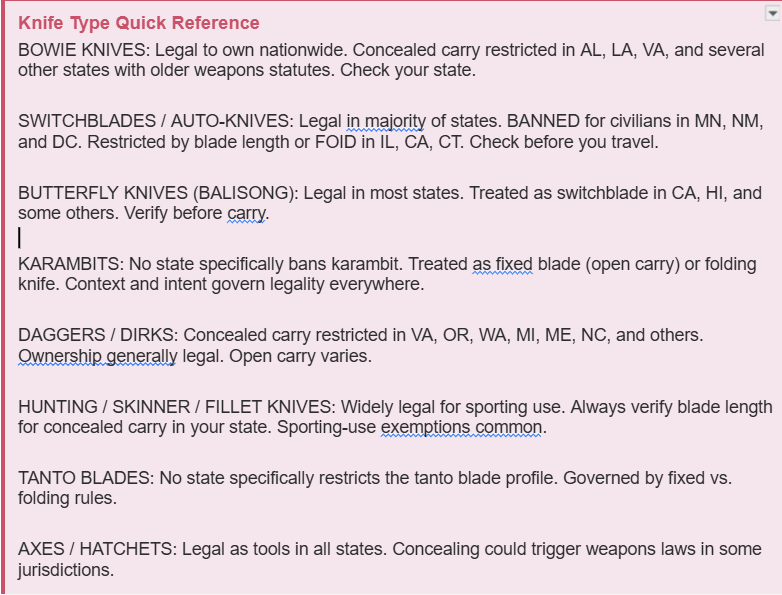
Knife-Type Legality by State Category
What to Verify Before You Carry: Your Pre-Carry Checklist
- Is the knife type (switchblade, fixed blade, balisong, etc.) legal to own in your state?
- Is the blade length within the statewide limit for open carry? For concealed carry?
- Does your state have preemption? If not, check the city and county laws
- Are you 18 or 21+ as required for this type of knife carry in your state?
- Are there any locations on your planned route or destination where knives are prohibited?
- If crossing state lines, have you checked the laws of ALL states you will transit through?
- If traveling by air, is the knife secured in checked luggage (never carry-on)?
- If the knife is automatic (switchblade/OTF), is it legal in your destination state specifically?
- Do you have any status (felon, restraining order, etc.) that restricts your carry rights?
- Is the venue you are attending (concert, event, arena) privately restricting knives regardless of state law?